Linked Lightning Spiral (Tsunagi Raimon)
Meaning
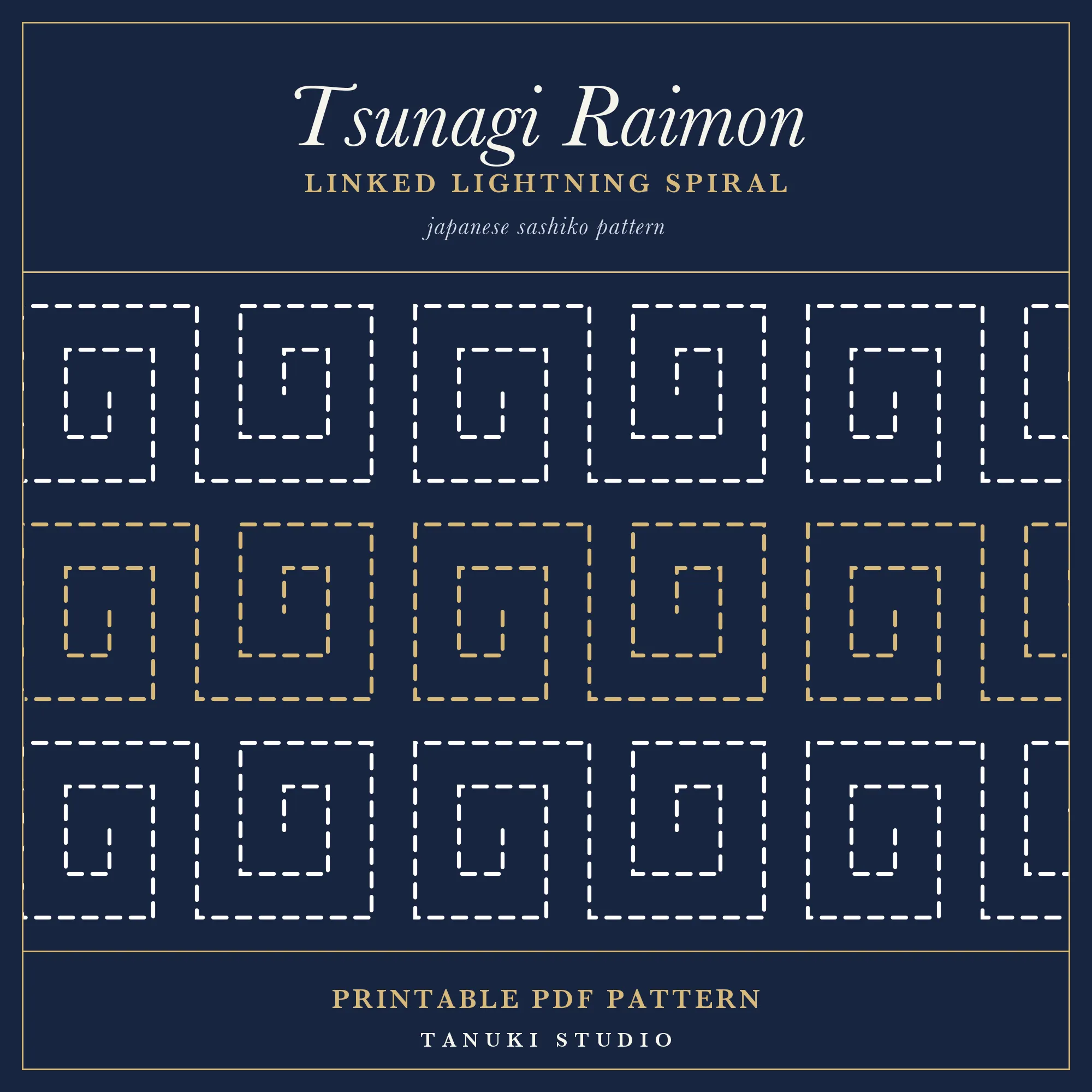
Tsunagi raimon links pairs of squared thunder spirals foot to foot into one unbroken chain. Tsunagi means linked or joined.
The meaning comes from raimon itself: thunder and lightning shaped into an ordered, protective line. Linking the spirals extends that continuity, with each one running straight into the next instead of sitting as a separate block.
History
This is raimon's own history, not a separate lineage. The design traces back to ancient Chinese cloud and thunder motifs found on Neolithic and Shang-dynasty pottery and bronzework, and its earliest known Japanese appearance is on Yayoi-period pottery, roughly 300 BCE to 300 CE, reflecting early contact with the continent. Its move into Japanese textiles came later and is documented more specifically: it entered by way of Ming-dynasty Chinese textile imports in the early Edo period, was worked into Noh costume as a ground pattern, and from there became a standard kimono and obi border motif that is still in use today.
Stitching notes
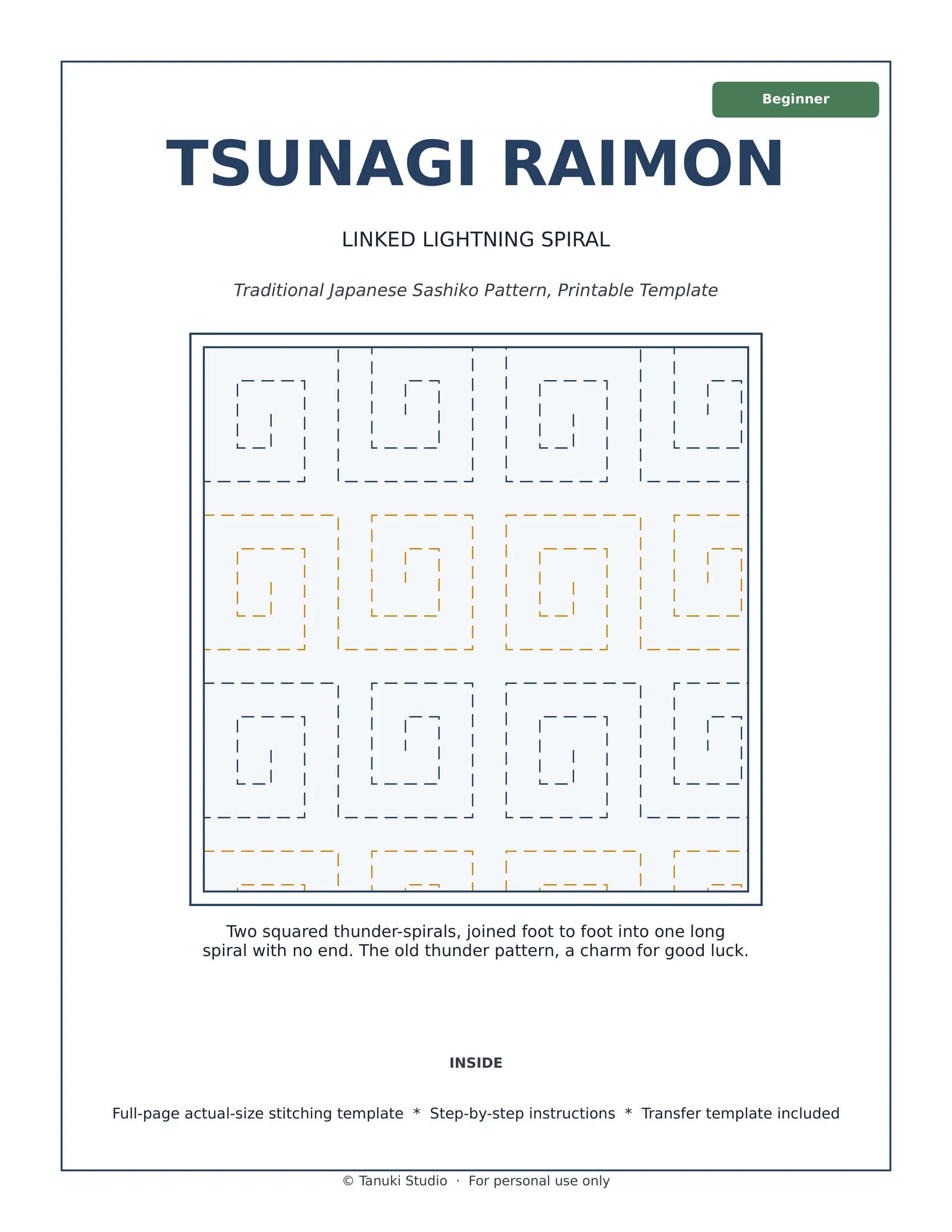
Tsunagi raimon links two mirrored square spirals into a single horizontal S, joined at a shared central spine, then tiles that unit in aligned rows across the fabric. Worked in two colors by row, one row of spirals in indigo, the next in gold, the piece is stitched one full spiral at a time rather than in one long continuous pass.
It’s rated beginner: every line is a plain running stitch worked on a simple grid, and because each spiral is self-contained, it’s easy to pick up and set down without losing your place.
Get the full pattern on Payhip
Additional sizes, an extended stitch guide, and a grid-spacing reference sheet.
Buy on Payhip → (opens Payhip in a new tab)Secure checkout via Payhip. Pay by card or PayPal.
Three free patterns, plus 15% off
Jūjizashi, Dan Tsunagi, and Komezashi, with a plain how-to for all three.