Hemp Leaf (Asanoha)
Meaning
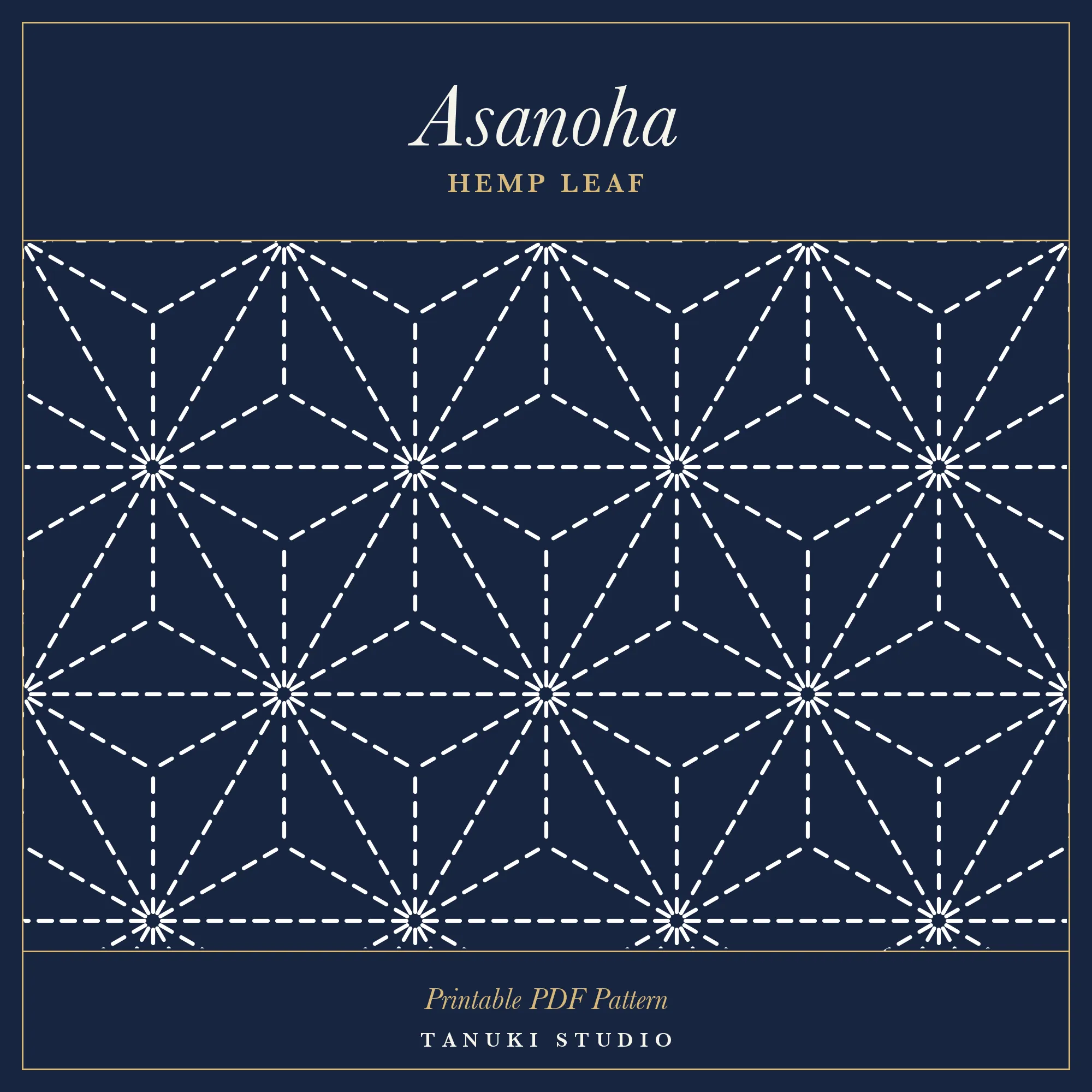
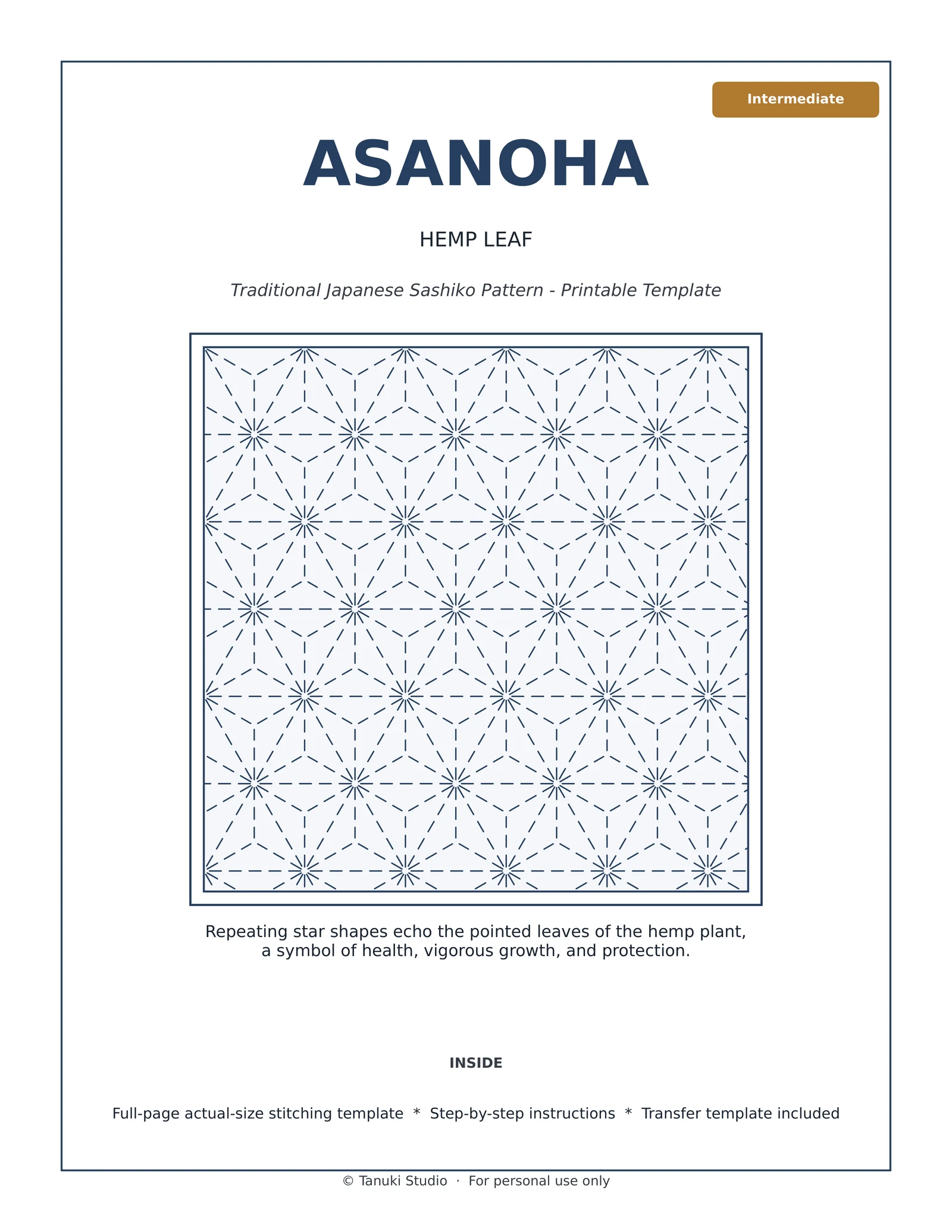
Asanoha means "hemp leaf." The six points echo the way hemp leaves spread from a shared stem, which is why the pattern has long been tied to growth, strength, and protection.
The full pattern includes printable templates, stitch notes, and a grid-spacing reference so you can mark it cleanly before you sew.
It is a good motif when you want the stitching to feel sturdy rather than delicate: a patch on worn denim, a baby gift, a table runner, or a single star framed in a hoop.
History
The pattern appears in Japanese Buddhist art by the Heian period (794 to 1185), before its later life in textiles. You will also see it connected with kumiko wood lattice, though that link is less firmly traced.
In the Edo period (1603 to 1868), Asanoha became widely used on kimono and children's clothing. The connection makes sense: hemp grows quickly, so the pattern became a wish for a child to grow strong and well.
Stitching notes
Asanoha starts with an equilateral triangular grid. Get that grid straight and the pattern gives you a lot back: the stars share their edges, so one stitched line helps build several shapes at once.
The first three passes are the calm part: horizontal lines, then the two diagonal directions. Keep the stitch length even, and leave the star centers open enough that the crossings stay clear.
The last two passes are the reason I call this Intermediate. They zigzag through the short inner spokes and make the small diamond path between the stars. Go slowly at each center point. Clean crossings matter more than speed.
Ways to use it
Best for
Mending patches, baby gifts, table runners, cushion fronts, and any project where you want a strong all-over pattern.
Watch for
The star centers. Leave a tiny bit of breathing room where the lines meet so the center does not turn into a knot of thread.
Why I like it
It looks intricate, but the first three passes are just straight lines on a grid. Once those are in, the pattern suddenly appears.
For this pattern: Use a fine-point fabric marker here. The star centers get crowded, and a thick chalk line can hide where the next stitch should land.
Get the full pattern on Payhip
Additional sizes, an extended stitch guide, and a grid-spacing reference sheet.
Buy on Payhip → (opens Payhip in a new tab)Secure checkout via Payhip. Pay by card or PayPal.
Three free patterns, plus 15% off
Jūjizashi, Dan Tsunagi, and Komezashi, with a plain how-to for all three.