Linked Tortoiseshell (Musubi Kikkō)
Meaning
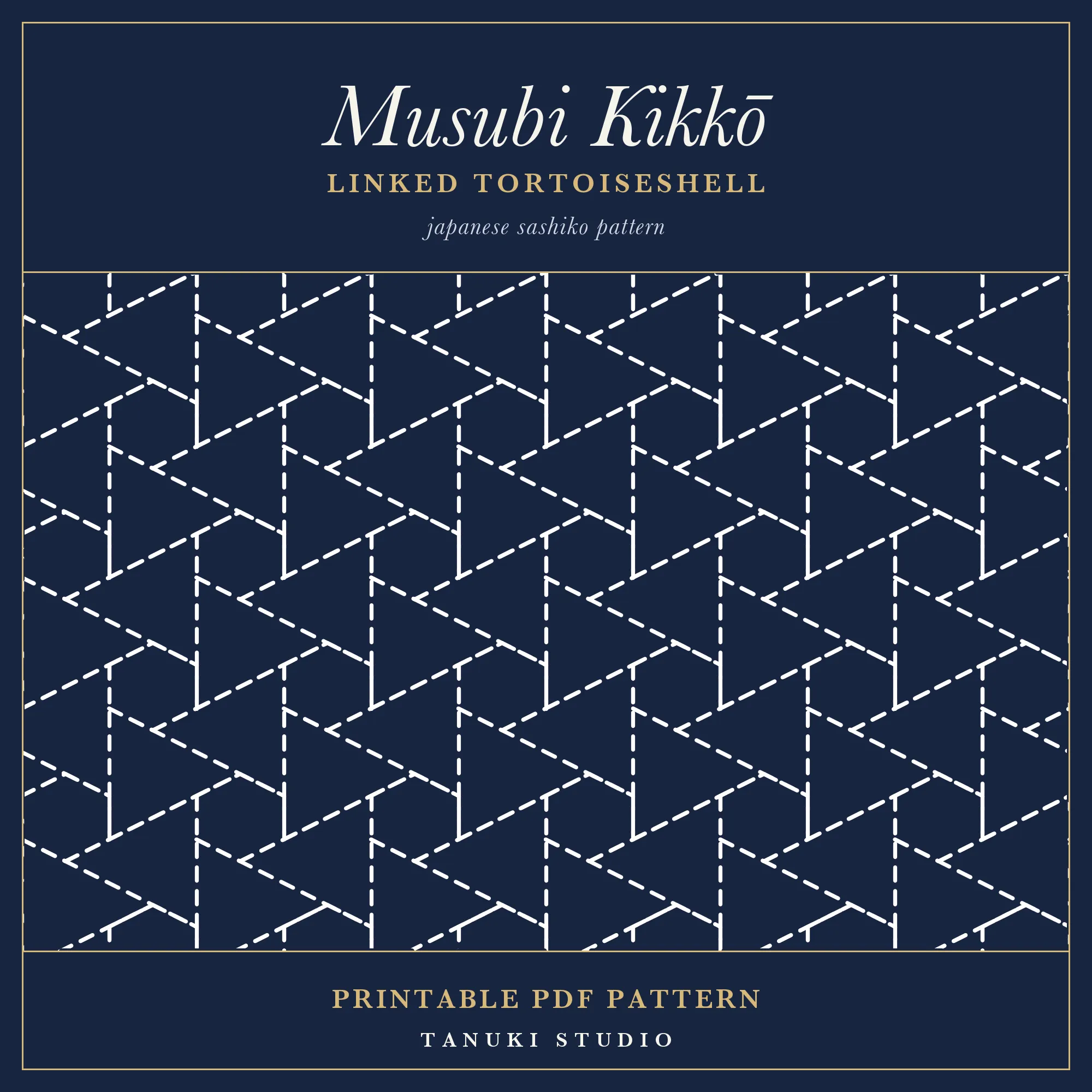
Musubi combines with kikkō, tortoiseshell, to mean tied or linked tortoiseshell. The hexagon tessellation reads as a stylized turtle's shell, and here it is extended a step further, with short upright stitches connecting one hexagon to the next like a knot holding two links together. Kikkō patterns as a family are classed among Japan's kisshō-mon'yō, or auspicious lucky-omen motifs, carrying the turtle's long-held association with longevity.
History
Kikkō's own history is long and well documented. The hexagon motif traveled to Japan from West and Central Asia by way of Silk Road contact with China, and it was already present in Japan by the Nara period on textiles preserved in the Shōsōin repository at Tōdai-ji Temple.
Musubi Kikkō sits within the wider kikkō family as a decorative elaboration: tortoiseshell cells tied together into a continuous field.
Stitching notes
Musubi Kikkō is built on a square-grid-flattened hexagon lattice rather than a true equilateral one, in keeping with how kikkō is traditionally marked out for stitching. Each repeating unit works out to ten line segments: a family of vertical lines plus two families of diagonals sloping in opposite directions, which together tile the hexagons and knot them to their neighbors.
It is taught in three color-coded passes, so you can see which segment family you are on without losing track partway through a hexagon. The grid marking is the exacting part. Once the lattice points are placed accurately, the hexagons and their connecting knots follow the same steady rhythm from one repeat to the next.
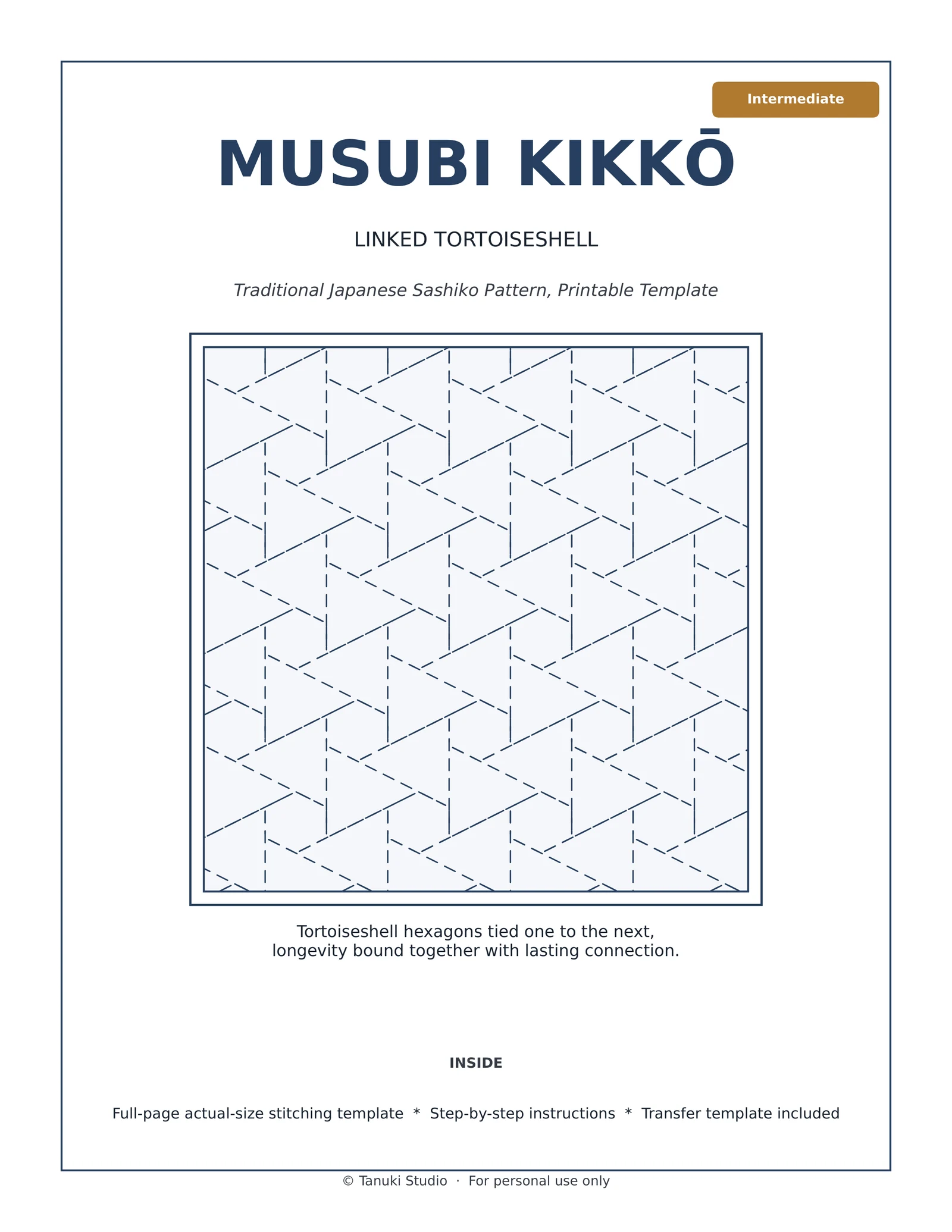
Get the full pattern on Payhip
Additional sizes, an extended stitch guide, and a grid-spacing reference sheet.
Buy on Payhip → (opens Payhip in a new tab)Secure checkout via Payhip. Pay by card or PayPal.
Three free patterns, plus 15% off
Jūjizashi, Dan Tsunagi, and Komezashi, with a plain how-to for all three.