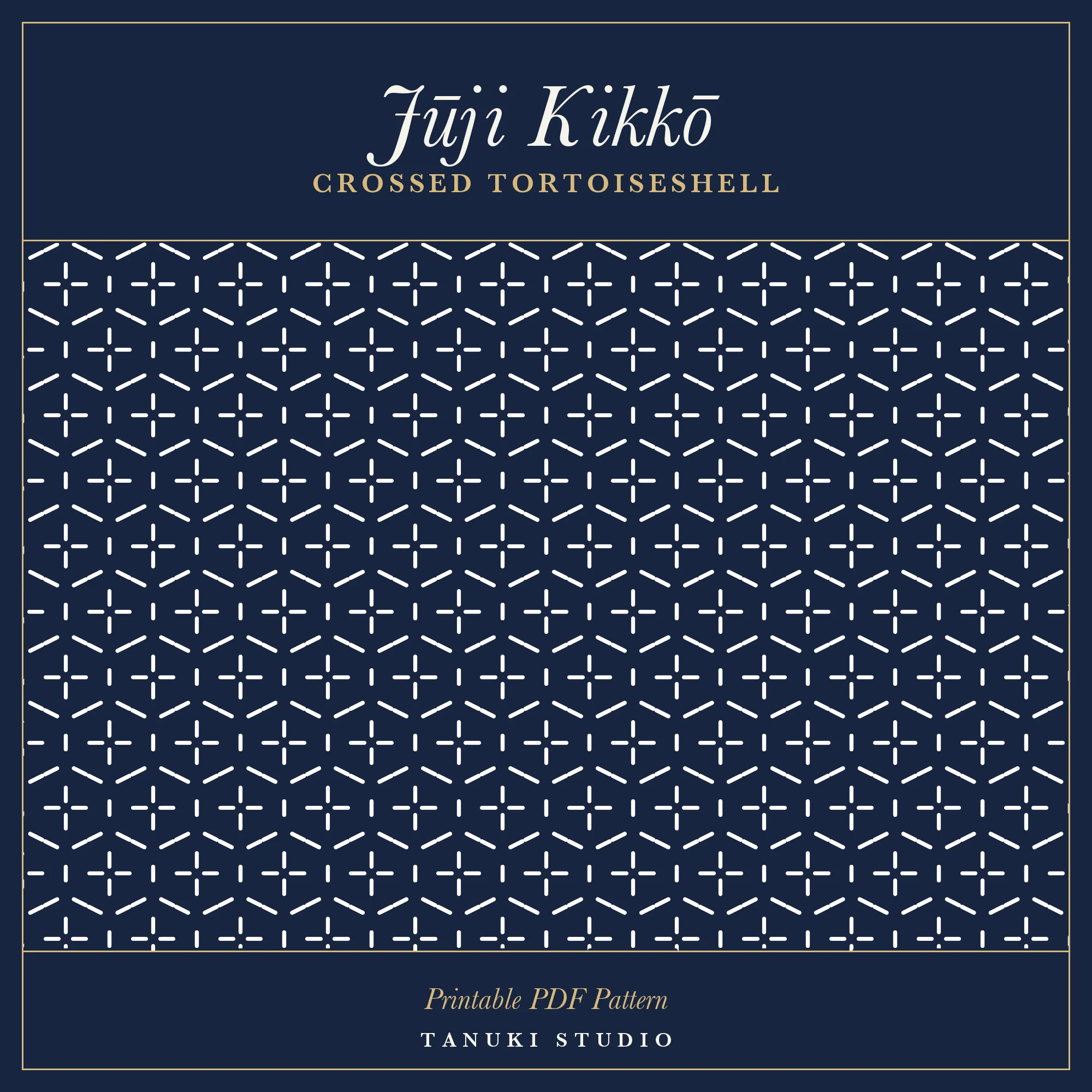
Crossed Tortoiseshell (Jūji Kikkō)
Meaning
Kikkō means tortoiseshell, the hexagon shape found on a turtle's carapace, and in Japanese tradition the turtle is a longstanding symbol of longevity and protection, captured in the old saying that the crane lives a thousand years and the turtle ten thousand. Jūji means cross. Jūji kikkō sets a small cross at the heart of every hexagon, layering that warding, long-life symbolism onto the stability of the honeycomb lattice itself, and it's one of several named kikkō variants alongside kikkō hanabishi (flower-filled) and bishamon-kikkō (three joined hexagons).
History
The kikkō hexagon originated in China, where the turtle carried similar associations of longevity, and the motif was brought to Japan and adopted during the Nara period (710 to 794), appearing in temple and shrine decoration. It gained further prestige in the Heian period, used in ceremonial objects and dress connected to the imperial court and aristocracy, and by the Kamakura and Sengoku periods it had moved into military use, most notably as small hexagonal plates of iron or hardened leather sewn to a cloth lining in samurai armor.
From there kikkō spread widely: kimono, ceramics, architectural fittings like sliding doors, and eventually into everyday textiles as the pattern moved beyond nobility and military use. Jūji kikkō, the cross-filled variant, belongs to this same family of "filled kikkō" designs, distinct from versions that fill each cell with a flower or nest smaller hexagons inside larger ones instead.
Stitching notes
Jūji Kikkō builds in a clear order: the hexagonal grid first, then the crosses that give the pattern its name. Work every vertical line top to bottom first; those lines form both the hexagons’ flat sides and the upright arms of the crosses.
Next, stitch the horizontal cross arms across each row. Finish with the zigzag slants that close the honeycomb into a continuous lattice. Each cross keeps a small open gap at its center rather than closing into a solid plus sign, which makes the finished pattern feel lighter.
The geometry looks dense before you start, but it settles once the first row or two of the grid is down. It is a good step-up pattern after simpler repeats: still running stitch, just more moving parts to keep aligned.
Ways to use it
An all-over panel
Jūji kikkō was traditionally worked as a dense, continuous field on kimono and armor, and it still reads best that way. A full panel or cushion front, worked edge to edge, lets the honeycomb-and-cross repeat build its rhythm the way it was meant to.
A book cover or passport wallet
Kikkō's role in armor plating gives it a clear connection to protection and structure. A stitched panel sewn into a book cover, passport wallet, or tool roll puts that old association to practical use on something you handle daily.
A longevity gift
Because kikkō carries a specific wish for a long life, a small hooped panel or patch makes a fitting handmade gift for a birth, an anniversary, or another milestone worth marking.
Your next-level swatch
If you've finished a simpler repeat and want more to think about, a modest swatch of jūji kikkō is a good place to practice keeping three stitch families (grid, cross, zigzag) aligned before moving to denser patterns.
For this pattern: Because more thread gets carried across the back here than in a simple single-line pattern, a smooth, tightly twisted sashiko thread holds up better than a fuzzier weight, which can pill or snag as it's pulled under previously stitched sections.
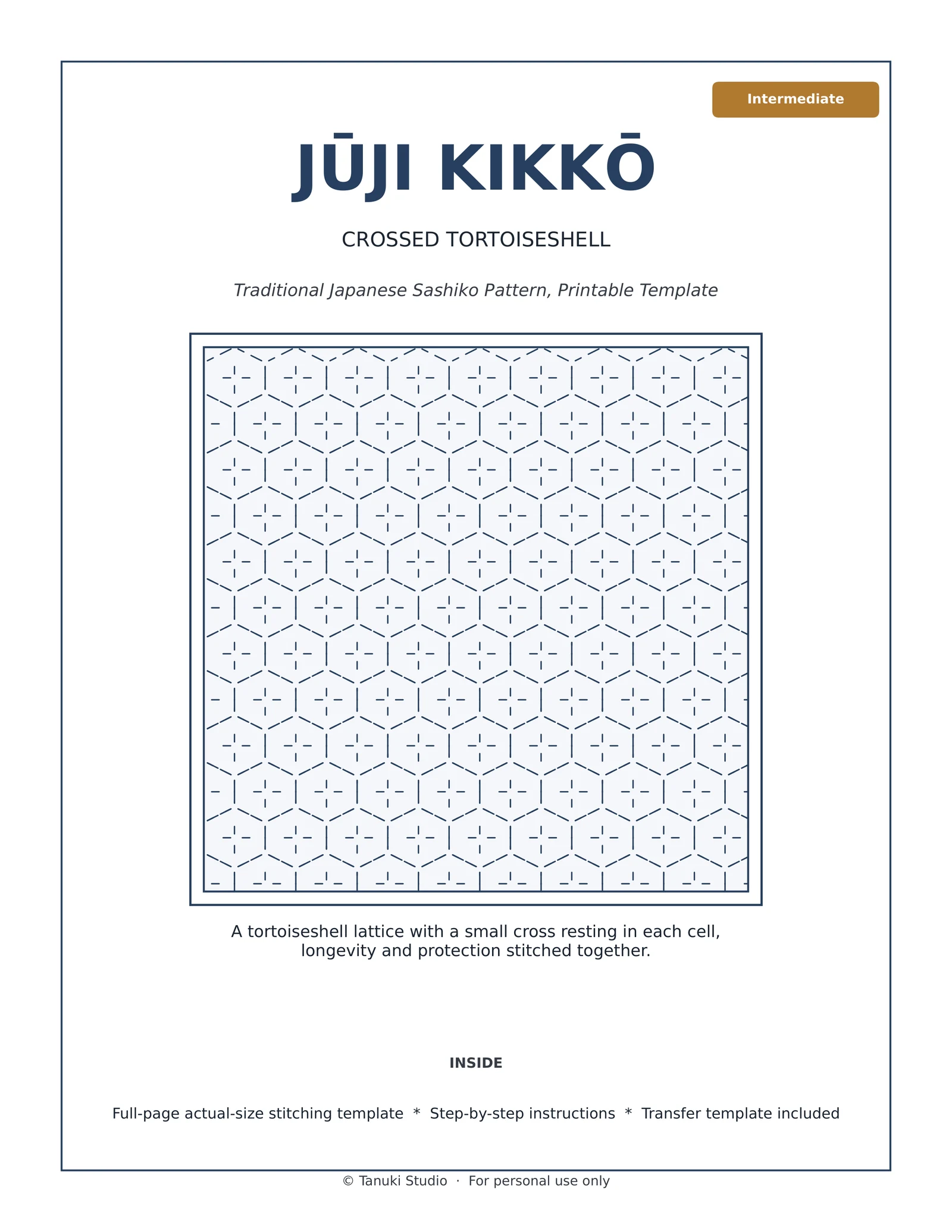
Get the full pattern on Payhip
Additional sizes, an extended stitch guide, and a grid-spacing reference sheet.
Buy on Payhip → (opens Payhip in a new tab)Secure checkout via Payhip. Pay by card or PayPal.
Three free patterns, plus 15% off
Jūjizashi, Dan Tsunagi, and Komezashi, with a plain how-to for all three.