Linked Cherry Blossoms (Sakura Tsunagi)
Meaning
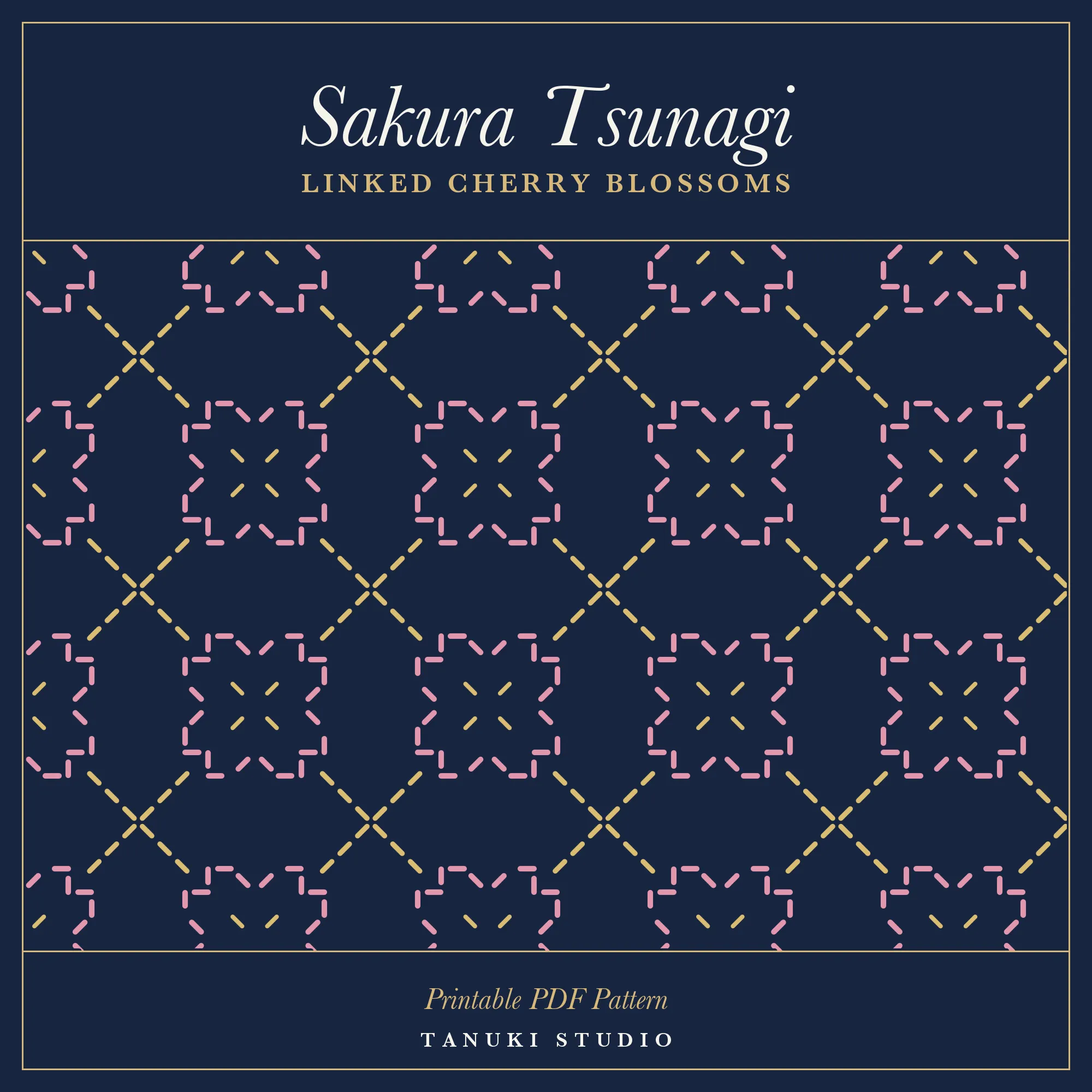
Sakura, the cherry blossom, carries one of the most well documented meanings in Japanese decorative art: mono no aware, the bittersweet awareness that beauty matters precisely because it doesn't last, drawn from the blossom's brief, glorious bloom and fall. Layered onto that is a reading of spring and new beginnings, reinforced by the blossom's timing at the start of Japan's school and fiscal year. Tsunagi simply means "linked," a construction word used across many unrelated sashiko motifs for a repeat joined edge to edge or corner to corner; here it describes how each closed, four-petal blossom connects diagonally to its neighbors through a worked running-stitch lattice, not a meaning unique to this particular combination.
History
Cherry blossoms have a long documented history in Japanese court and popular culture. Courtly taste shifted from plum to cherry blossom among Heian-period poets, hanami viewing began as an aristocratic pastime in that same era, and by the Edo period cherry blossom imagery was common in ukiyo-e prints, kimono, and seasonal decoration. Named cherry blossom family crests are cataloged by the dozens, usually with five petals to match the real flower.
Sakura Tsunagi works as a modern chart combination: cherry blossoms joined by a linking lattice. This four-petal, wide-spaced version is a construction choice, not a period crest variant.
Stitching notes
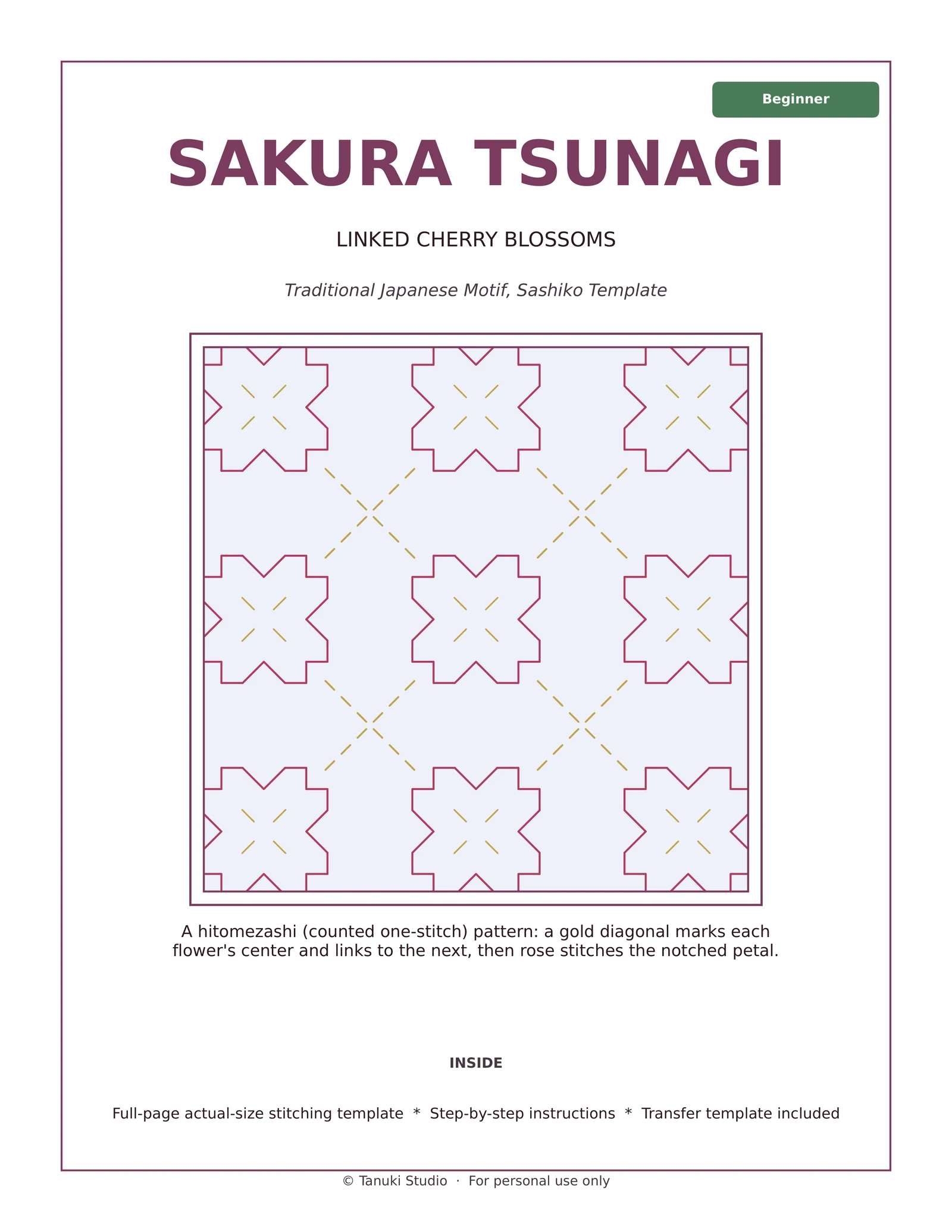
Sakura Tsunagi is a hitomezashi (one-stitch) pattern: every stitch covers exactly one grid segment. Each blossom is built from four notched petals set on the diagonal, with every half-petal stepping through single diagonal, vertical, and horizontal stitches in sequence, so the closed outline reads as a soft four-point flower rather than a sharp star. The flowers sit a generous two inches apart, deliberately looser than a tip-to-tip packing, which keeps the notched petal shape easy to read even worked in two colors.
The stitching runs gold first: a diagonal lattice of single stitches that links each flower’s center to the next across the whole piece. Once that lattice is in, the thread switches to rose for each flower’s petal outline. This is one of the fastest patterns in the shop, a good first try at working two colors in one piece.
Get the full pattern on Payhip
Additional sizes, an extended stitch guide, and a grid-spacing reference sheet.
Buy on Payhip → (opens Payhip in a new tab)Secure checkout via Payhip. Pay by card or PayPal.
Three free patterns, plus 15% off
Jūjizashi, Dan Tsunagi, and Komezashi, with a plain how-to for all three.